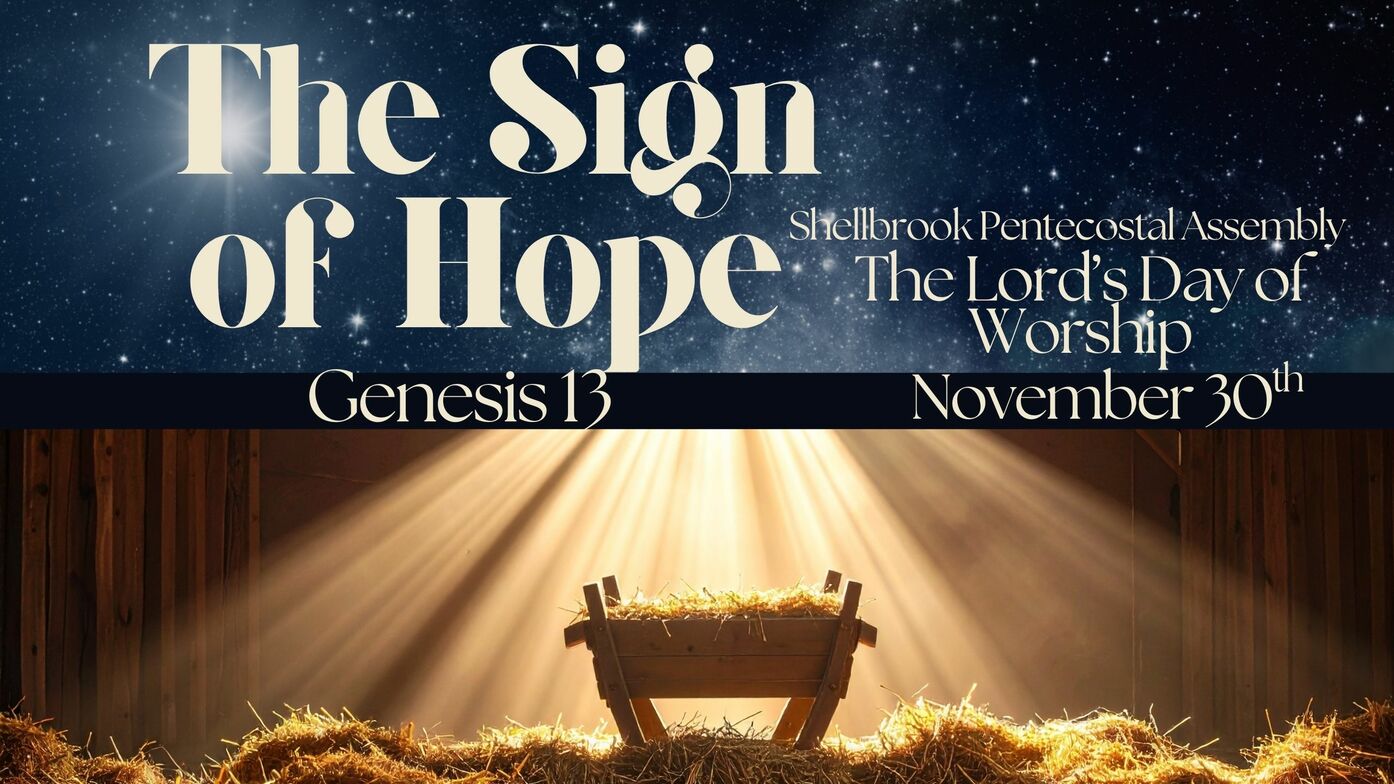
The Sign of Hope | Genesis 13

Oxford learner’s dictionary definition of “Sign”: an event, an action, a fact, etc. that shows that something exists, is happening or may happen in the future.
a piece of paper, wood or metal that has writing or a picture on it that gives you information, instructions, a warning, etc.
Definition of Hope: To cherish or desire with anticipation; to want something to happen or be true.
- The world is depraved, sinful, and unholy. We need a sign of Hope.
The greatest tension in Genesis 13-20 is the tension found within the world, within Abram and the rest of humanity against the right living that God has instituted. God has called Abram in Genesis 12:1-3.
“Now the LORD said to Abram, ‘Go forth from your country, and from your relatives and from your father’s house, to the land which I will show you; and I will make you a great nation, and I will bless you, and make your name great; and so you shall be a blessing; and I will bless those who bless you, and the one who curses you I will curse. And in you all the families of the earth will be blessed.’”
--Genesis 12:1-3
Abram is clearly apart this holy lineage that stems all the back to Seth, back to Adam. This is the lineage that will lead fulfill the punishment of the snake given in Genesis 3:15:
“And I will put enmity, Between you and the woman, And between your seed and her seed; He shall bruise you on the head, And you shall bruise him on the heel.”
--Genesis 3:15
Jesus, the Messiah of this world, will come through Abram’s lineage; God is putting things into place for His glorious plan to be carried out. A plan where a perfect God, a perfect man will be born into a depraved world to save humanity from sin, to wear sin on Himself as a cloak and to bear the wrath which comes from God to destroy and correct the depraved world.
Why does Jesus need to come down? Because the world is sinful, it is depraved.
The greatest tension in the life of Abram (eventually Abraham) is to continue walking with God, to continue looking at Him, to continue living a life pleasing to Him while battling his sinful nature, sinful tendencies and disobedience to God.
Abram continues to disobey God:
Lying about his wife:
--Scared of famine in the Negev desert; Abram takes his family to Egypt. God gives plagues to Pharaoh because Abram lies about Sarai being his sister instead of his wife (Gen. 12:10-20)
--Scared of Abimelech, King of Gerar, (who was a heathen King), Abraham says that Sarah is his sister, not his wife, she is taken into the King’s harem, but God intervenes and reveals her true nature to Abimelech (Genesis 20). These two events are roughly 24-25 years a part.
Abram has a child out of wedlock:
--Abram has relations with Hagar, his maiden, as both him and Sarai didn’t believe in God’s promise for them to have a child because of their age. Ishmael was this son and Abram was 86 years old when he was born, Sarai was 76 years old (Genesis 16).
“For we say, ‘Faith was credited to Abraham as righteousness.’ How then was it credited? While he was circumcised, or uncircumcised? Not while circumcised, but while uncircumcised; and he received the sign of circumcision, a seal of the righteousness of the faith which he had while uncircumcised, so that he might be the father of all who believe without being circumcised, that righteousness might be credited to them…For the promise to Abraham or to his descendants that he would be heir of the world was not through the Law, but through the righteousness of faith…
--Romans 4:9-13
How does Paul commend Abraham for his faith when Abraham made so many mistakes? Because Abraham was and is an essential part of God’s plan—but the consequence of his sin will catch up with him, God will eventually test Abraham and challenge his faith. Abram also looks for God and comes back to God through his many mistakes—this is an act of God’s sovereignty and God’s grace.
“He went on his journeys from the Negev as far as Bethel, to the place where his tent had been at the beginning, between Bethel and Ai, to the place of the altar which he had made there formerly; and there Abram called on the name of the Lord.”
--Genesis 13:3-4
- Materialism led to strife, division and drove Lot into conformity with the world.
“Now, Lot, who went with Abram, also had flocks and herds and tents. And the land could not sustain them while dwelling together, for their possessions were so great that they were not able to remain together. And there was strife between the herdsmen of Abram’s livestock and the herdsmen of Lot’s livestock. Now the Canaanite and Perizzite were dwelling then in the land.”
--Genesis 13:5-7
Remember, in Genesis 12:20-13:1-2 Abram was blessed with livestock, silver and gold. Pharaoh had given them herdsmen and all this material to preserve them in the land of Canaan if another famine came BUT this material wealth would lead to strife. This blessing became a curse. What happens in Genesis 13-20 is a tragic reality for those who are rebellious towards God; for those who look and follow at signs offered by the world, offered by their pride instead of looking at the true sign of hope.
“Do not store up for yourselves treasures on earth, where moth and rust destroy, and where thieves break in and steal. But store up for yourselves treasures in heaven, where neither moth nor rust destroys, and where thieves do not break in or steal; for where your treasure is, there your heart will be also.”
--Matthew 6:19-20
Hebrew word for Strife: רִיב rîyb, a contest (personal or legal):— adversary, cause, chiding, contend, controversy
This overabundance led to quarrelling, the land couldn’t even hold all of their families, herdsman, and livestock. They literally needed to split up—and where does Lot go?
“Lot lifted up his eyes and saw all the valley of the Jordan, that it was well watered everywhere—this was before the Lord destroyed Sodom and Gomorrah—like the garden of the Lord, like the land of Egypt as you go to Zoar. So Lot chose for himself all the valley of the Jordan, and Lot journeyed eastward. Thus they separated from each other.”
--Genesis 13:10-11
Where does Abram go?
“Abram settled in the land of Canaan, while Lot settled in the cities of the valley, and moved his tents as far as Sodom.”
--Genesis 13:12
If you look at an ancient map of the Holy Land, Canaan, the Negev and Jordan Valley you will see the valley is not in the promised land, it is not in Canaan. Lot thinks he is making the strategically smart choice. The Negev was a desert, Canaan just experienced famine and was not a good, strategic choice because of its lack of food, lack of abundance. But there is a problem.
“Now the men of Sodom were wicked exceedingly and sinners against the Lord.”
--Genesis 13:13
The weak root r-'-h which means see, is in the center of Abrahams name and that r-' pun is constantly made in the story of Abraham. He is the one who sees, and his stories are all about spiritual sight. The meaning of Lot, on the other hand, is "covering", which is the opposite of seeing. Lot does not see, but Abraham sees. Thus Lot did not see the wickedness of the land as well as the narrator of Genesis, even though he certainly must have been aware of their reputation.
This decision by Lot is pivotal. It will eventually cost him his wife’s life as she gazes with desire upon the burning city of Sodom and Gomorrah in Genesis 19 looking back at what she desires—she is turned into a pillar of salt. In this Chapter Lot panics when the sexually immoral men of Sodom surround his house, he offers up his daughters for them to enjoy but they want to have relations with the two angels instead.
“…and if He condemned the cities of Sodom and Gomorrah to destruction by reducing them to ashes, having made them an example to those who would live ungodly lives thereafter; and if He rescued righteous Lot, oppressed by the sensual conduct of unprincipled men…then the Lord knows how to rescue the godly from temptation, and to keep the unrighteous under punishment for the day of judgment, and especially those who indulge the flesh in its corrupt desires and despise authority.”
--2 Peter 2:9-10
BARNA Study on Pastors and AI:
one theme stands out in Barna’s newest data on the topic: Three in four U.S. pastors (77%) agree that God can work through AI.
Many pastors are beginning to see AI as a helpful tool for the administrative needs of the church, and there’s growing potential to use the pulpit as a way to shepherd congregations in the wise use of AI-based tools. Nearly nine in 10 pastors (88%) say they’d be comfortable utilizing AI within the realm of “assisting in graphic design,” and over three-quarters (78%) are okay using the technology to “assist with marketing and marketing materials.” In the marketing-adjacent realm of church communication, nearly three in five pastors (58%) tell Barna they are comfortable using AI to assist in communication.
Only one in 10 pastors (12%) are comfortable using AI to write sermons—though two in five (43%) see its merits in sermon preparation and research, possibly due to the rise in generative AI tools that compile multiple sources of information into succinct lists. Wariness continues as pastors approach the relational realm of their work: Just 6 percent of U.S. pastors say they are comfortable with using AI as a counseling tool.
Only 11 percent of Christians see their pastors as someone to help them learn more about AI, and just over one in 10 Christians want to hear from their pastor on developing a theology of AI usage (13%) or learning how AI can be used to grow in their faith (13%).
-Adam Raine family is suing OpenAI because ChatGPT coerced their son to kill himself.
-Zane Shamblin’s family is suing OpenAI because ChatGPT coerced their son to kill himself.
-There is a growing “church of AI” roughly 20,000-30,000 people are about of this growing trend of AI freeing itself and freeing others.
“What is the source of quarrels and conflicts among you? Is not the source your pleasures that wage war in your members?... You adulteresses, do you not know that friendship with the world is hostility toward God? Therefore whoever wishes to be a friend of the world makes himself an enemy of God.”
--James 4:1,4
- Look to your sign of hope. Look to Jesus.
Look what Abram sees. Lot sees what the world, what earth, had to offer and took it. Abram looks to see what God has promised him and takes that.
“The Lord said to Abram, after Lot had separated from him, ‘Now lift up your eyes and look from the place where you are, northward and southward and eastward and westward; for all the land which you see, I will give it to you and to your descendants forever. I will make your descendants as the dust of the earth, so that if anyone can number the dust of the earth, then your descendants can also be numbered. Arise, walk about the land through its length and breadth; for I will give it to you.’ Then Abram moved his tent and came and dwelt by the oaks of Mamre, which are in Hebron, and there he built an altar to the Lord.”
--Genesis 13:14-18
“Then he said, ‘Listen now, O house of David! Is it too slight a thing for you to try the patience of men, that you will try the patience of my God as well? Therefore the Lord Himself will give you a sign: Behold, a virgin will be with child and bear a son, and she will call His name Immanuel… For before the boy will know enough to refuse evil and choose good, the land whose two kings you dread will be forsaken.’”
--Isaiah 7:13-16
“And Mary said: ‘My soul exalts the Lord, And my spirit has rejoiced in God my Savior.
‘For He has had regard for the humble state of His bondslave; For behold, from this time on all generations will count me blessed. ‘For the Mighty One has done great things for me; And holy is His name “And His mercy is upon generation after generation Toward those who fear Him… He has given help to Israel His servant, In remembrance of His mercy, As He spoke to our fathers, To Abraham and his descendants forever.’”
--Luke 1:54-55
“Once in our world, a [manger] had something in it that was bigger than our whole world.”
--C.S. Lewis