The Gift of Generosity | Romans 12:8

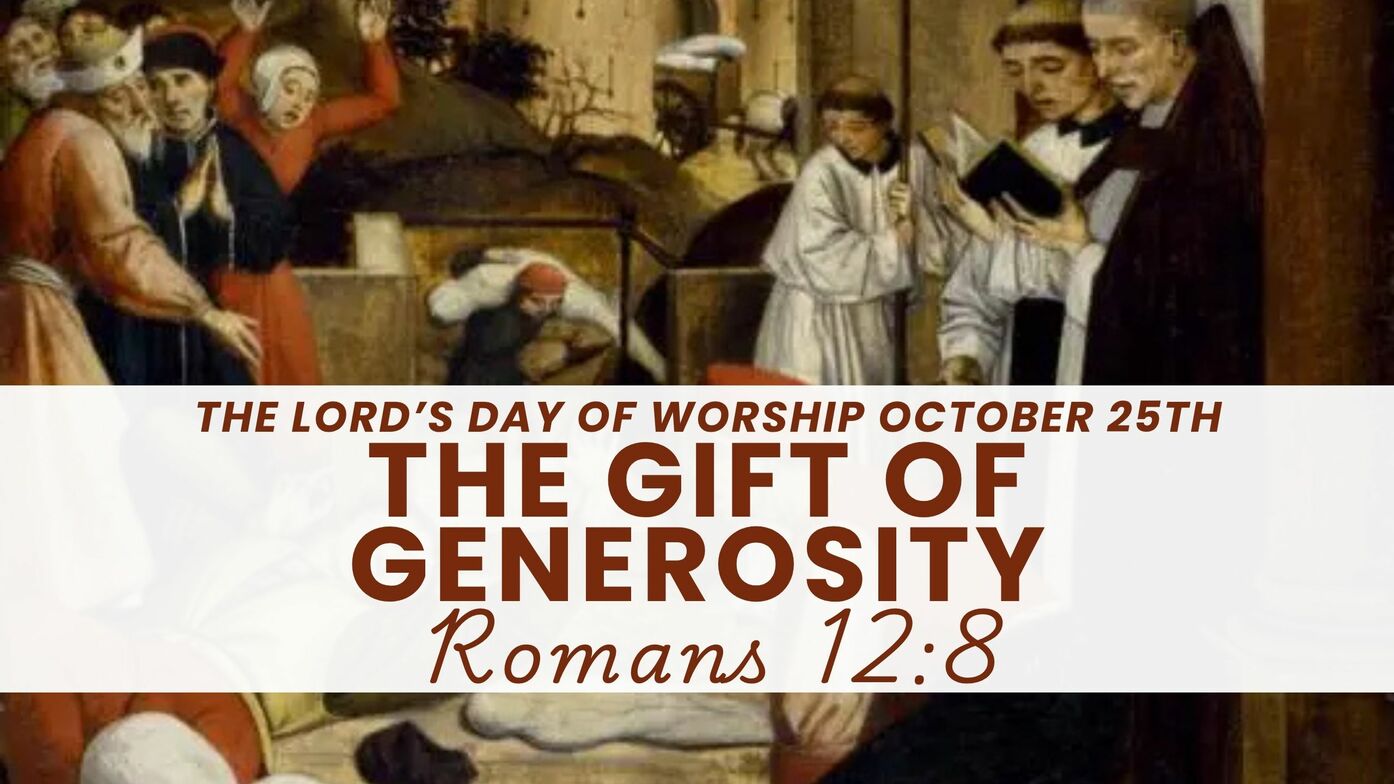
Remember the beginning of this Chapter:
“Therefore I exhort you, brothers, by the mercies of God, to present your bodies as a sacrifice—living, holy, and pleasing to God, which is your spiritual service of worship.”
--Romans 12:1
This whole chapter is instructional for the church in Rome in what “spiritual service of worship” looks like for God’s Church. God gives His church gifts for the spiritual service of worship which glorifies Him and shines His gospel in a world full of sin, darkness.
God sends a faithful prophet to come to God’s people in Jerusalem, Judah to call them out of idolatry, false worship. Israel, God’s people, are not taking care of each other, they are not being generous with the poor, they are worship Baal, Aherath, Molech AND worshiping God I the Holy Temple on the Sabbath. God is upset and calls their worship “worthless.”
SLIDE 2
“Bring your worthless offerings no longer, Incense is an abomination to Me. New moon and sabbath, the calling of convocation— I cannot endure wickedness and the solemn assembly. ‘My soul hates your new moon festivals and your appointed times, They have become a burden to Me; I am weary of bearing them. So when you spread out your hands in prayer, I will hide My eyes from you; Indeed, even though you multiply prayers, I will not listen. Your hands are full of blood.’”
--Isaiah 1:13-15
Isaiah calls them to repentance—look what the repentance, what that function looks like:
SLIDE 3
“Wash yourselves, purify yourselves; Remove the evil of your deeds from before My eyes. Cease to do evil, Learn to do good; Seek justice, Reprove the ruthless, Execute justice for the orphan, Plead for the widow. ‘Come now, and let us reason together,’ Says Yahweh, ‘Though your sins are as scarlet, They will be as white as snow; Though they are red like crimson, They will be like wool. If you are willing and obey, You will eat the best of the land;”
--Isaiah 1:16-19
SLIDE 4
“For I long to see you so that I may impart some spiritual gift to you, that you may be strengthened”
--Romans 1:11
SLIDE 5
- A Sign of a Healthy Church is they Operate in Generous Sharing.
SLIDE 6
“…he who gives, with generosity; he who leads, with diligence; he who shows mercy, with cheerfulness.”
--Romans 12:8b
“To Give”
μεταδίδωμιi,; to give over, i.e. share:—give, impart. and exhorts those who minister in things temporal, to do so as "sharing,"
“Generosity”
ἁπλότης, singleness, i.e. (subjectively) sincerity (without dissimulation or self-seeking), or (objectively) generosity (copious bestowal):—bountifulness, liberal(-ity), simplicity, singleness.
Paul is calling the church to impart and share in a selfless manner, with bountifulness, without debt attached—give without wanting or needing something in return. Paul knows this is extremely hard to do for a sinful people which is why he ends this sentence “with diligence; he who shows mercy, with cheerfulness.” Be happy in your sharing, in your generosity, not self-seeking but ever giving to those in the church family, in your life, in your ministry.
Paul addresses different gifts in 1 Corinthians 12 and Romans 12.
SLIDE 7
“For to one is given the word of wisdom through the Spirit, and to another the word of knowledge according to the same Spirit; to someone else faith by the same Spirit, and to another gifts of healing by the one Spirit, and to another the workings of miracles, and to another prophecy, and to another the distinguishing of spirits, to someone else various kinds of tongues, and to another the translation of tongues. But one and the same Spirit works all these things, distributing to each one individually just as He wills.”
--1 Corinthians 12:8-11
Paul is writing a more “practical” list to the Roman church not necessarily because these churches had an issue of being selfish (maybe they did) but Paul knew that Roman culture had an issue with political piety, selfishness and self-aggrandizement.
The Roman Emperors were selfish. Remember, during this time a Roman Imperial Cult existed that taught and forced Roman citizens to worship Caesar as God. Some emperors were deified and their power almost seemed to be untouchable at times. The Empire was seen as strong, almost godlike. There were temples to Caesar all over the Roman empire, temples where citizens were to literally worship the government.
The roman culture would have struggled with political piety above all—if you are not practicing in these Roman forms of worship then you were to be punish. This created a self-piety and self-aggrandizement of the Roman Empire above all places, cultures and empires.
SLIDE 8
“In the 2nd and 1st centuries BCE, amidst the crisis of the Roman Republic and the rise of powerful military generals, political propaganda became increasingly vital. After the assassination of Caesar in 44 BCE, his posthumous deification in 42 BCE and the construction of the Temple of Divus Iulius in the Forum Romanum in 29 BCE provided the institutional vocabulary later adopted by the Eastern provinces. Octavian/Augustus’s self‐presentation as divi filius, his role in the restoration of traditional Roman religion and his association with the goddess Roma all contributed to a model that the Greek cities would adapt.”
-- Paolo Cimadomo, PhD “Digital Scholarships in the Humanities,” fqag103, https://doi.org/10.1093/llc/fqag103
Paul is reminding the church of their function as a CHURCH! As God’s CALLED OUT PEOPLE! In the midst of a chaotic, pagan overtly powerful Roman world—Romans 12 and 13 will do two things:
A). It will remind God’s people of their place in God’s family while still living in a sinful world.
B). It will put the government in their place as a tool which God uses, they are under God and do nothing apart from God. This leaves them powerless compared to a powerful God.
This should ENCOURAGE and EMBOLDEN God’s people to not live and act like a Roman but rather to live and act like a child of God—like a Christ Follower rather than a child of Rome.
“The measure of a life, after all, is not its duration, but its donation.”
--Corrie Ten Boom
SLIDE 9
- A Sign of a Healthy Church is they give their lives to Christ, their breath, their abilities, their talents, their worship is given to Christ as their Lord.
SLIDE 10
“…he who shows mercy, with cheerfulness.”
--Romans 12:8
The Roman world was not merciful, people are not merciful, every sinful culture is not merciful vengeance is mine! Vengeance is deserved! We love stories, movies, songs, art about taking revenge. God reminds the church of this and tells them there is a greater way, a way of generosity, of sharing, of taking care of each other as God’s people and outreaching with mercy to those around us generously.
SLIDE 11
“…or he who exhorts, in his exhortation; he who gives, with generosity; he who leads, with diligence; he who shows mercy, with cheerfulness. Never paying back evil for evil to anyone, respecting what is good in the sight of all men, if possible, so far as it depends on you, being at peace with all men, never taking your own revenge, beloved—instead leave room for the wrath of God. For it is written, “Vengeance is Mine, I will repay,” says the Lord. “But if your enemy is hungry, feed him, and if he is thirsty, give him a drink; for in so doing you will heap burning coals on his head.”
--Romans 12:8, 17-20
The church has been wildly generous with charity throughout its entire history, since Christ instituted it.
a). The early church in Rome helped save babies who were to be discarded because of deformities or imperfections. In the 400 AD’s the church even built marble slabs or pockets in the walls of their churches so people could drop their babies off in them. In 1198 (medieval times) Pope Innocent III built “The Foundling Wheel” which was built into the exterior wall of the Santo Spirito Hospital near Vatican City. Mothers placed their baby inside, spun the wheel, then rang the bell (anonymously) so give their babies to the church.
b). The Roman church sent a huge sum of financial capital to the church in Greece. In 170 AD, Bishop Dionysus of Corinth wrote a letter thanking the Roman Christians for sending financial capital to Greece to help the fledgling and poor Christian congregations in Greece. They also used this capital to help support Christians who were lower class / criminals who were condemned to work in the imperial mines.
c). The Bubonic Plague was a major outbreak of disease that spread across Europe/ Asia between three major pandemics. During the second and third (majorly popular) outbreak in, 1347-1771 the plague ravaged across these countries. 60% of people died from it, 25 million died of the plague from 1347-1352. In 1656-1657, two thirds of the population in Naples and Genoa died from the disease.
The church had an amazing response to the plague. They doubled down on holding church services and help some midweek church services on the street or in homes—people were hungry for God. The church’s position was the plague was God’s judgement on them because their culture was like Sodom and unholy.
One of the fastest dying group of people during the plague was clergy and servants of the church. The general public’s mortality rate was roughly 30% and the clergy’s mortality rate was 42%-45% (40%-50% in monastic communities). This was the case because clergy and the church were actively helping people who were sick with the plague. They were anointing with oil and praying, performing last rites, helping bury people in mass / large graves thus they were always getting sick and dying because they were exposing themselves to people to help them, pray for them, and share the gospel with them.
There was a group within the church called Flagellants who would literally whip themselves and cause bleeding, they denied the gospel, denied the sacraments and taught their way of cleansing was more powerful than God’s—there is always an imperfect side to the church, a weird side, a rebellious side because many think they are biblical Christians but they are not.
SLIDE 12
“Then Jesus said to His disciples, ‘If anyone wishes to come after Me, let him deny himself, and take up his cross and follow Me. For whoever wishes to save his life will lose it; but whoever loses his life for My sake will find it. For what will it profit a man if he gains the whole world and forfeits his soul? Or what will a man give in exchange for his soul? For the Son of Man is going to come in the glory of His Father with His angels, and will then repay each one according to his deeds.’”
--Matthew 16:24-27
SLIDE 13
“And when they came to the place called The Skull, there they crucified Him and the criminals, one on the right and the other on the left. But Jesus was saying, ‘Father, forgive them; for they do not know what they are doing.” And they cast lots, dividing up His garments among themselves.’”
--Luke 23:33-34
Later, on the cross, Jesus literally asks God, The Father, to forgive those who are scoffing at Him, who are casting lots, gambling for His clothes, the men who tortured Him and hung Him on a cross. You see Christ was so generous that He literally gave up His perfect life to die in our place, Christ didn’t have to die, but He did die for His enemies—we at one point in our lives were enemies of Christ. Rebellious in our sin, loving ourselves instead of loving Christ, loving His church and loving the lost so much we share the gospel of Jesus through our charity and generosity.
SLIDE 14+15
“Let no one deceive you with empty words, for because of these things the wrath of God comes upon the sons of disobedience. Therefore do not be partakers with them, for you were formerly darkness, but now you are light in the Lord; walk as children of light (for the fruit of that light consists in all goodness and righteousness and truth), trying to learn what is pleasing to the Lord.) And do not participate in the unfruitful works of darkness, but instead even expose them. For it is disgraceful even to speak of the things which are done by them in secret. But all things become visible when they are exposed by the light, for everything that becomes visible is light”
--Ephesians 5:6-13
We need to get out of our Canadian comforts and stand up for the truth of Christ in our workplaces, our town, our schools. We need to speak the truth and show mercy with a cheerful attitude. We need to understand that God is in control, God is working, there is nothing to fear and there are so many who need to hear the truth, love, mercy and gospel of Christ—many will see that when the church shares their gifts in a generous way, when the church shows mercy and has a cheerful heart especially when the circumstances are dire.
SLIDE 16
“Lord Jesus, it is for thee that I patiently endure this cruel death. I pray thee to have mercy on my enemies.”
--Jan Hus (1370-1415).