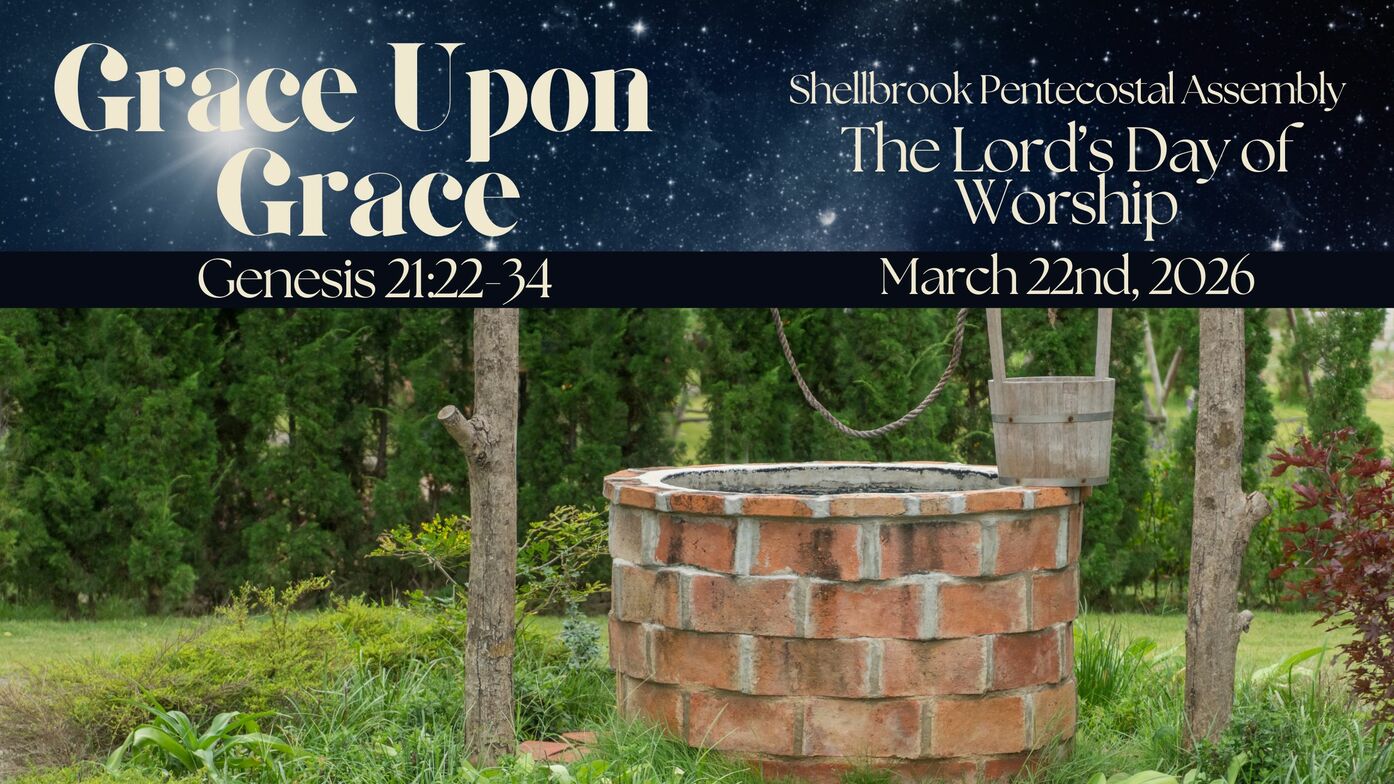
Grace Upon Grace | Genesis 21:22-34

We must remember where Abraham and Sarah are located as God’s promise is fulfilled through Isaac’s birth in Genesis 20 & 21. They are in the Negev desert, in the land of Gerar which is ruled by the Philistine king Abimelech.
“And Abraham journeyed from there toward the land of the Negev and settled between Kadesh and Shur; then he sojourned in Gerar.”
--Genesis 20:1
Abraham and Sarah are sojourners in Gerar. They are not refugees, they are not illegal immigrants, they are partly assimilated into Gerar and willing to abide by the laws of the Philistine King.
Sojourn: ר gûwr, goor; a primitive root; properly, to turn aside from the road (for a lodging or any other purpose). To dwell for a time, to inhabit within a community, assimilated to the governing laws.
ξένος xénos, xen'-os; apparently a primary word; foreign (literally, alien, or figuratively, novel); by implication, a guest or (vice-versa) entertainer:—host, strange(-r).
“For I was hungry , and you gave Me something to eat; I was thirsty, and you gave Me something to drink; I was a stranger, and you invited Me in; naked, and you clothed Me.”
--Matthew 25:35
Abraham and Sarah are strangers in Gerar and in this piece of scripture we will see how they assimilate into the land and how God uses Abimelech to bless them and to preserve His plan.
- God works through all people; for His glory, to show us how Jesus will save the world.
Last week we looked at the importance of the first-born child in the ancient cultures. Paul calls Jesus “The Firstborn of all Creation” (Colossians 1:14) and that goes both ways. He was the first human, the eternal God man himself “Let us make man in our image” Gen. 1:27 and we are made copies of Christ—then He is also the first born of all creation since He has resurrected from the grave, He is the first resurrected thus providing salvation for His people as we have Faith Alone in Christ Alone—we will follow Him in resurrection.
Just as Israel is the first-born child of God (Ex. 4:22-23) the gentiles are welcomed into God’s promised family through the blood of Jesus. This means that God’s people, will come to salvation through their jealousy of the gentiles (Romans 11:11-14).
We can see hints of this, foreshadowing, even prophetic instances where God doesn’t JUST work through Israel and the Jewish people rather God works through all of creation, all of humanity, so that His glory may shine.
Here God works, again, through the heathen King Abimelech to provide blessing for Abraham and Sarah.
“Now it happened at that time, that Abimelech and Phicol, the commander of his army, spoke to Abraham, saying, God is with you in all that you do; so now, swear to me here by God that you will not deal falsely with me or with my offspring or with my posterity, but according to the lovingkindness that I have shown you, you shall show me and the land in which you have sojourned.”
--Genesis 21:22-23
This portion of scripture highlights a specific need that Abraham, Sarah and their entire camp has—a need for a place to stay, that has living water, that will sustain them and give them a chance to live. Gerar was in an ancient, Canaanite city state which was fortified and located in the western part of the Negev. It was a fertile crescent with much water and covered 40 acres of land—modern day Tel Haror is accepted as Ancient Gerar.
The city was known for its abundance of water wells giving them power, control and setting the stage for God to provide a place to live for His people.
“Your staff, they comfort me. You prepare a table before me in the presence of my enemies;”
--Psalm 23:4-5
- God is the giver of Life, of sustenance, of security and hope.
We see here a dispute over a well. This is significant because Abraham knows how important this well will be for their life, their well being, the continued support of their family—they will not be able to have a home without a well.
“But Abraham reproved Abimelech about the well of water which the servants of Abimelech had seized. And Abimelech said, ‘I do not know who has done this thing; you did not tell me, nor did I hear of it until today.’”
--Genesis 21:25-26
Water wells are extremely important throughout the entirety of Scripture. They symbolize life, sustenance, agreement, covenant and even community / relationships and marriage. The well was the centre of community life—many men went to the well to find a suitable bride because it was typically the women’s job to go and get the water from the well.
In Genesis 29 Jacob falls in love with his cousin Rachel at a well and shows off his strength by pulling the cover off the well.
“And he said to them, ‘Is it well with him?’ And they said, ‘It is well, and here is Rachel his daughter coming with the sheep.’ And he said, ‘Behold, it is still high day; it is not time for the livestock to be gathered. Give water to the sheep to drink, and go, pasture them.’ But they said, ‘We cannot, until all the flocks are gathered, and they roll the stone from the mouth of the well; then we give water to the sheep to drink…Jacob came near and rolled the stone from the mouth of the well and gave water to the flock of Laban his mother’s brother to drink.’”
--Genesis 29:6-8
This language of waiting for the flocks to be gathered and for the stone to be rolled away plays as significant even in this previous Covenant made with Abimelech as Abraham exchanged seven ewes for the well.
In Genesis 33:18-20, Jacob, makes his camp right outside of Shechem and bought a portion of the land, a parcel of land, where we know he built his well which would give God’s people, his family, security, life because of the water.
God makes promises in the Old Testament and the New Testament which point to blessing His people with waters of life, with salvation, water that will no longer make one thirst. As water is essential for a healthy and secure life on earth God is offering it in a promise to His beloved people.
You see, Abraham knows he needs clean water to ensure survival—clean water is vital to a living and healthy civilization. We need drinking water, we need clean water to clean our bodies, to stay hygienic and even to process / cook food properly—water is essential to life.
“Do not fear, O Jacob My servant, And you Jeshurun whom I have chosen, For I will pour out water on the thirsty ground And streams on the dry land; I will pour out My Spirit on your seed.”
--Isaiah 44:2-3
Jesus would fulfill this prophecy found in Isaiah 44:2-3. He would point it out to the Samaritan woman in John 4, a woman He met at the well directly outside the ancient city of Shechem, the same well Jacob dug, and God supplied for his family and children of Jacob’s family.
“Jesus answered and said to her, “If you knew the gift of God, and who it is who says to you, ‘Give Me a drink,’ you would have asked Him, and He would have given you living water.” She said to Him, ‘Sir, You have nothing to draw with and the well is deep. Where then do You get that living water? ‘Are You greater than our father Jacob, who gave us this well, and drank of it himself and his sons and his cattle?’ Jesus answered and said to her, ‘Everyone who drinks of this water will thirst again; but whoever drinks of the water that I will give him will never thirst—ever; but the water that I will give him will become in him a well of water springing up to eternal life.’”
--John 4:10-14
Statue of Liberty
What an amazing gift! In 1865 a French Legal Scholar and abolitionist, proposed the idea of building an amazing gift the United States to celebrate his countries democratic values and assistance to the US during the American Revolution. His country was France and his name was Edouard de Laboulaye. He proposed to build America an amazing statue which would stand 305 and 1 inch high and made entirely out of copper sheets. America would have to build the pedestal for it to stand on. It took 9 nines to make / build the statue and it was dedicated on October 28,1886.
“So Abraham took sheep and oxen and gave them to Abimelech, and the two of them cut a covenant. Then Abraham set seven ewe lambs of the flock by themselves. And Abimelech said to Abraham, ‘What do these seven ewe lambs mean, which you have set by themselves?’ He said, ‘You shall take these seven ewe lambs from my hand so that it may be a witness to me, that I dug this well.’ Therefore he called that place Beersheba, because there the two of them swore an oath.’”
--Genesis 21:27-31
God is the giver of Life, of sustenance, of security and hope.
Beersheba in Hebrew means “well of seven,” or “the well of the oath/treaty”
- Abraham turns to God at Beersheba; laying a foundation for His descendants to Repent and find God.
“And Abraham planted a tamarisk tree at Beersheba, and there he called upon the name of Yahweh, the Everlasting God. And Abraham sojourned in the land of the Philistines for many days.”
--Genesis 21:33-34
Tamarisk trees are a salt cedar and live a long time, they have very long taproots and can get up to 15 feet high.
Planting seeds for Future Generations
--In Genesis 26 Abraham’s son, Isaac, moves into Gerar because of famine in Canaan, Philistines have filled the wells with sand, Isaac reopens those wells and builds new ones (Vs. 18-22).
--Isaac goes to Beersheba and finds Yahweh…
“And Yahweh appeared to him that night and said, ‘I am the God of your father Abraham;
Do not fear, for I am with you. I will bless you and multiply your seed, For the sake of My servant Abraham.’ So he built an altar there and called upon the name of Yahweh and pitched his tent there; and there Isaac’s servants dug out a well.”
--Genesis 26:24-25
“Beersheba was also the place where Samuel’s two wicked sons served as leaders (1 Samuel 8:1–3). It was this perversion of the judgeship that led Israel to demand a king (1 Samuel 8:6–9). By the time of the prophet Amos, in the reign of King Uzziah, Beersheba seems to have become a center of false worship, and the prophet warns those who would truly worship the Lord, ‘Do not journey to Beersheba’ (Amos 5:5). Today, the spot where Beersheba once stood is marked by ancient ruins; several ancient wells have been discovered in the area, and they still produce water.”
--GotQuestions.org
--Beersheba is an actively spiritual place. A place where men met God, where God provided for His people, a place that laid a foundation for future generations to find God, to be rebuked by God and to pull them into God’s presence in times of doubt or uncertainty.
This Chapter, this word, this Bible, this church family and how God worked through His people reminds us of the amazing Grace Upon Grace God has given His people which God has given us.
“The church is not something additional or optional. It is at the very heart of God’s purposes. Jesus came to create a people who would model what it means to live under His rule. It would be a glorious outpost of the kingdom of God, an embassy of heaven. This is where the world can see what it truly means to be human. Our identity as human beings is found in community. Our identity as Christians is found in Christ’s new community. And our mission takes place through communities of light. Christianity is ‘total church’.”
--G.K. Chesterton
“I believe that if there is one thing which pierces the Master’s heart with unutterable grief, it is not the world’s iniquity but the church’s indifference.”
--John Piper